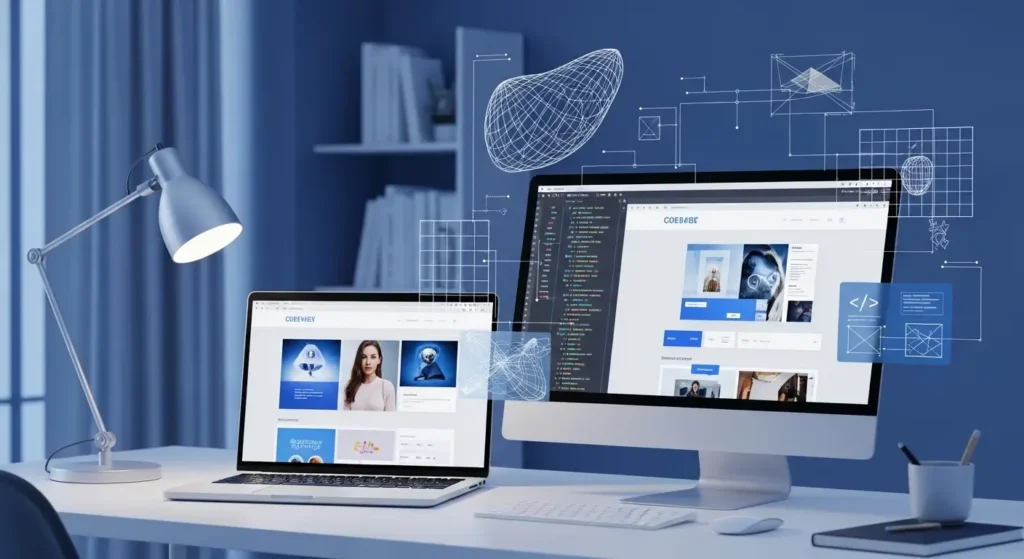
Web Design & Development takes center stage in the digital business journey. Businesses use websites as presentation tools and as interactive platforms that do sales for them. Businesses competing for premium clientele demonstrate their digital professionalism with premium digital websites.
Design & Development urges creativity for intersectional cross-professional synergies. A website that is visually appealing, easily navigable, and upheld by affordable privacy and security protocols is a web designer and a business professional’s responsibility. A website is the face and presentation of a business.
What is Web Design & Development?
Web Design & Development is a process that includes both the creation of a page and the maintenance of that page to satisfy both the expected outcomes that the page should meet, as well as the business objectives of the organization sponsoring the page. The creation of a page is the result of designers and developers working in tandem to create a functional continuum in a digital space.
The Digital Presentation
Web Design & Development is not a scratch on the surface of digital professionalism. Coloration, typography, and placement (layout) are presentation interactions that create an image of professionalism and demonstrate the value of organizational investments to the clientele.
Web Development
Web Development is the main technical aspect of creating a website. There is a lot of coding or programming involved. There is also front-end development and back-end development. Front-end is what the users see, and back-end involves server-side processes development.
Good development establishes a website’s foundations for users. A strong foundation makes a site fast, safe, and ensures good growth potential. In the field of Web Design & Development, a good developer makes the choice of site development based on currently available tools to ensure they achieve the goal of making a site perform.
Why Web Design & Development is Big for Today’s Business
For today’s business, Web Design & Development is a top priority, and in the digital world, it secures a business’s competitive advantage. Websites that are well built not only draw interest: they also become buyers’ communication points.
Getting a positive first impression is a huge reason to invest in Web Design & Development. Stuff that is cringe in Web Design & Development speaks negatively. Design and usability create opinions that most clients form, and if a site is dominating the cringe zone, clients will not stick.
User Experience is an often-neglected but critical website aspect. A good site is built with many factors that ensure users will not abandon it. Those factors are good navigation, high performance (fast and responsive), and it also accommodates the devices that the users accessing it are currently using.
Using Design & Development to secure a better result from Web Design & Development is another great benefit. There are many factors to creating a good site, and every aspect of interactive Web Design a developer should keep at the top of mind. Those factors include a site that is fast, accommodates mobile users, has good navigation, great performance, high speed, and is safe. Those are the key factors for interactive Web Design and Development. H2 The Basics of Web Design & Development Defining Web Design & Development is the first step a business can take to help achieve interactive and successful Web Design and Development.
User Interface (UI) Design
Designing UI centers on the visual aspects of what users see, including buttons and menus, and what users interact with. This includes website layouts. UI helps users navigate the website, and ease of access is a key region of focus for UI design. It should be convenient, seamless, and help users navigate and find the information they need quickly.
User Experience (UX) Design
Creating a visual design is not enough. You should focus on building a unique experience for users on the website. What do you want them to feel by the end of their interaction? What do you want them to be able to do? Designing for easy access to information is key. Identifying the information/needs of the users, and ensuring they are easy to complete, is your job, so ensure you gain maximum interaction and satisfaction from the users.
Front-End Development
Visual and UI/UX aspects of the website are determined and also designed by Front-End Development. It deals with the interaction of the website on the client side. It encompasses client-side scripting of the website and its implementation. This includes the use of HTML, CSS, and JavaScript.
Back-End Development
While Front-End Development deals with the client-side scripting and design, Back-End Development deals with everything that happens on the server side. It deals with the management of servers and databases, and the logic of the applications you are creating.
Types of Websites in Web Design & Development
Various types of websites can have different applications for your business. You must ensure to choose the website type that fulfills your business needs to the maximum.
Corporate Websites
Corporate websites serve to represent a business by informing visitors about services offered. Focus is placed on proving credibility to potential clients.
E-commerce Websites
E-commerce websites enable a business to sell products directly on the website. This builds a business’s online presence while integrating product listings, shopping carts, and payment systems.
In Web Design & Development, e-commerce businesses place special emphasis on the platform’s shopping experience, prioritizing security and performance.
Portfolio Websites
Portfolio websites allow one to build a profile of one’s work. They are especially useful for designers, developers, and agencies, who rely on creative work.
Web Design & Development Process
The Web Design & Development process is a series of steps that lead to the end result.
The process starts with Research & Planning. Here, business objectives are set. This is followed by identifying a target market. In the design phase, the layouts and prototypes are drafted and presented.
In the development phase, the design is translated into the website through coding and programming. Once development is over, testing comes next. This process is automated with popular website development platforms to ensure the site is bug-free and can handle the intended performance load.
Regular updates and changes to the site are part of its maintenance. Structured processes build a reliable website for a client.
SEO in Web Design & Development
SEO is a fundamental aspect of Web Design & Development. It increases the likelihood of attracting visitors by improving a webpage’s rank in a search engine.
SEO has phases. Content, headings, and keywords are fixed. Performance and appearance have to be consistent with the function of the webpage. It has to load and respond quickly. These are special areas for improving a webpage’s core. These are the technical aspects of SEO.
Incorporating SEO into your Web Design & Development could lead to greater growth and visibility over time.
Security and Privacy in Web Design & Development
In today’s Web Design & Development, security is of utmost importance. A secure site protects the data of your users and leads to increased trust from your customers.
Security measures include, but are not limited to, secure hosting and SSL certificates. With these measures, the likelihood of a cyberattack is decreased, and data is protected.
In addition to the above measures, the priority of securing and protecting the data of your users should not be denied. When designing a website, a business should consider the data of its users, how they are protecting that data, and the laws and regulations that protect that data.
Benefits of Professional Web Design & Development
There are many benefits to be gained from Professional Web Design & Development. When a business invests in the Professional Web Design & Development they are immediately perceived as more credible. A great Professional Web Design & Development means a more credible business, more productive employees, and a competitive advantage, among other things.
The hiring of a Professional Web Design & Development means a website is more responsive, faster, and more functional. These things create more satisfied customers and lead to greater profits.
The hiring of a Professional Web Design & Development means greater flexibility in the future, as well. A greater flexibility means a company is more adaptable. This is especially important in a competitive market.
Common Mistakes to Avoid
When designing a website, there are common mistakes that must be avoided. A common mistake is an over-complicated website. This leads to a confusing experience for the user.
Another mistake is failing to design for mobile. The majority of users browse the web via mobile.
In addition to the above issues, slow response time and weak security are major problems. These things lead to a distrust of the company.
Conclusion
Success in modern business hinges on quality web design and development. With professionally designed and well-staffed creative websites, an improvement in conversion rates, user experience, and brand image becomes evident.
The quality web design and development will yield an equally strong and enduring positive online presence. This positive online presence will secure business growth. A strong website is most critical in today’s competitive business environment, where several online presentations have become commonplace.